


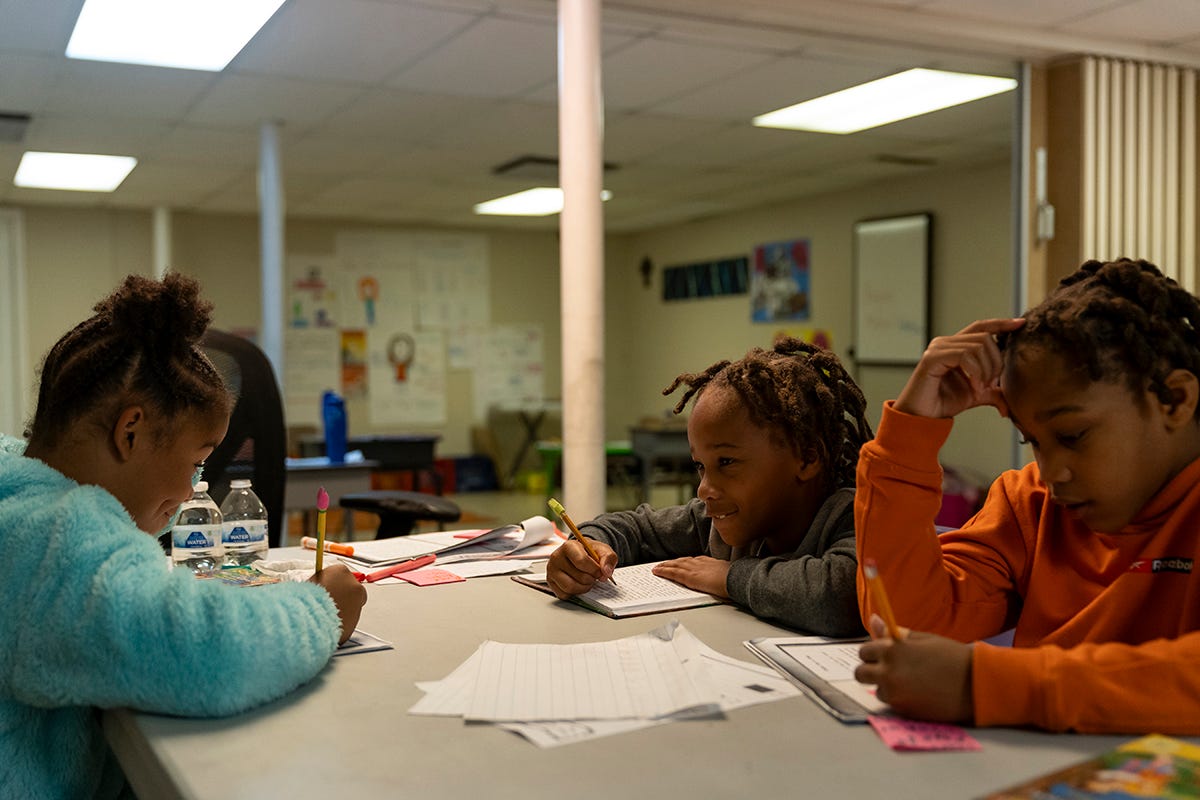
LOUISVILLE, KY—More Grace Christian Academy is located inside a small, run-down church in the West End, the poorest neighborhood in the biggest city in Kentucky. In 2021, at the height of Covid school closures, Cecil Blye opened the school, named after the nearby church where he serves as pastor.
There are about a dozen kids, almost all black, from first through twelfth grade. By the time most of them started at the school, Blye told me, they were at least two to three grade levels behind. He said none of their parents pay the school’s $100 a week tuition because they can’t afford it. Instead, he has to run the school for about $5,000 a month from whatever money the families can cobble together—sometimes $50 a week, sometimes nothing at all—plus the income he gets from his church and the donations of friendly neighbors and strangers.
In this neighborhood, where Blye grew up in a since-demolished housing project, 58 percent of children live below the poverty line, the streets are plagued by violent crime, and just six percent of students at some public schools read at state standard levels. But Blye has no doubt that his school would blossom if “school choice”—shorthand for giving parents state education money to send their children to private school—became law in Kentucky.
“We’d be able to fully fund what we do here because each kid would come with a payroll attached that would enable us to buy their curriculum, pay for their breakfast and lunch, and pay teachers,” he told me.
“We already know that what we’ve been doing doesn’t work,” Blye said of local public schools. “If we try something new and it doesn’t work, then we just would drop it. But how do we know if we don’t try?”
Just over a dozen states in the U.S. have laws that allow school choice. Most of them are red states—including Alabama, Oklahoma, and Florida—because in the national debate over education, the issue has long been championed by conservatives, who see school choice as a means of pushing back against culture war issues such as library books with LGBTQ content or how race is taught in schools. Liberals, especially the big-city teachers unions, argue that any law that diverts public dollars would essentially defund public schools.
But the deep red state of Kentucky does not allow school choice, because its constitution decrees that funds for education can go only toward public schools. Unlike many states, Kentucky doesn’t even offer charter schools, which can serve as a public school alternative. Last December, when the state’s legislature passed a law to allow charter schools, a judge struck it down as unconstitutional.
Then, this year, Kentucky’s Republican-controlled legislature approved Amendment 2. If passed by voters on November 5, the measure would amend the state’s constitution to allow public tax dollars to go toward private schools. School choice would finally be legal in Kentucky.
