

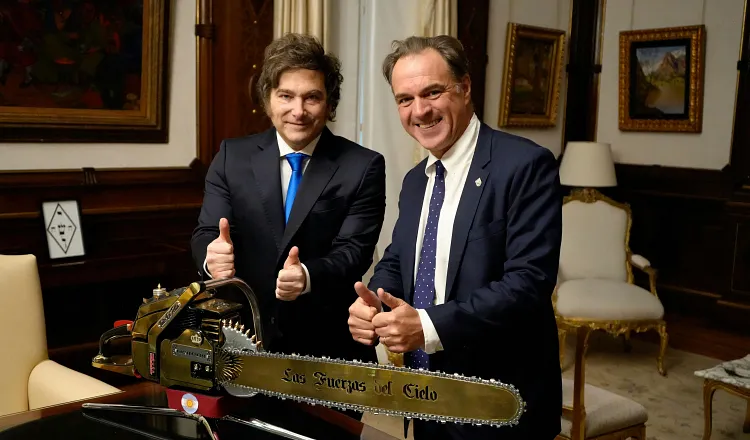
The prerequisite for an economic miracle is an economic disaster. As I wrote in these pages late last month, Argentine president Javier Milei inherited just such a disaster from his Peronist predecessor in December 2023: a currency on the brink of hyperinflation, a contracting economy, a government reliant on the International Monetary Fund.
What he has achieved in the subsequent year and a half is one of the wonders of the world economy today. (Read here; it really is a miracle.)
But—as he himself acknowledged during our conversation last week at the presidential palace in Buenos Aires—it is too early to celebrate an Argentine economic miracle. Political obstacles remain, not just sustaining his achievement thus far, but also launching the next and crucial phase of his radical plan to make Argentina “the world’s freest country.”
The Milei I met was not what I had expected. On social media, he presents himself as a rock star, cavorting onstage, yelling into the mic, tossing his mop of dark hair. Most profiles emphasize his eccentricities, most famously the pack of cloned dogs he has named after his favorite economists.
In the crepuscular light of the presidential office in the Casa Rosada (the Pink House), where the shutters are kept closed as he dislikes bright light, he cuts a very different figure. He is soberly dressed in a dark suit and blue tie. He has a smooth routine for greeting visitors, pointing out the chainsaw that has become the symbol of his drastic cuts in government spending—as if it were time-honored presidential regalia. Photographs are taken and we sit down at a large, glass-topped table.
Only when Milei begins to answer my questions does it become clear that he is no ordinary president.
To call Milei professorial would be an insult. He has always been too much of a dissident—too libertarian on economics, too conservative on social questions—to have played any part in modern academic life. But he is, first and foremost, an intellectual, a man so in love with ideas that nothing excites him as much—certainly not the formal trappings of presidential authority. Yet he is also a man of the people, who relishes his occasional lapses into profane language. And he is learning, late in life, the realities of South American politics.

I spent an hour and a half talking to President Milei. Below is our conversation, lightly edited for length and clarity:
Niall Ferguson: What have you learned since becoming president that you didn’t know before?
Javier Milei: I always thought that politicians were truly horrid and despicable beings. When I took office after several months as a member of Congress, a journalist interviewed me and asked me what I thought about politicians. I replied that I had been wrong. And the journalist launched into a strong defense of journalists, interrupting my answer. What I wanted to say was that I had been wrong because I had fallen short of stating the full truth, which is that politicians are far worse than I could have imagined.
