


Ships are burning in the Strait of Hormuz. There are rumors that the Iranians are laying underwater mines. An American submarine has torpedoed an enemy warship for the first time since the Second World War. Oceans are now battlefields.
But can America triumph in this arena? We’re not making enough ships—and the ones we have are out of date. Last April, President Donald Trump signed an executive order to “restore America’s maritime dominance”—but the bureaucracy of the “Big Five” defense contractors is making it hard to do that.
Enter: the ocean-trepreneurs.
An Indian-born NASA-trained engineer who’s building flying boats for the Navy. A former Amazon employee who’s making self-piloting seaplanes. An Irish guy who’s making underwater drones that, he says, could help take out the Iranian mines rumored to be planted in the Persian Gulf. Suzy Weiss spoke to them in San Francisco, where the great Pacific Ocean meets the West’s best technicians.
You’re not going to want to miss this.

SAN FRANCISCO — It all started with the fighter jets doing tricks over the bay. It was San Francisco Fleet Week, the annual fall festival when the Navy show squadron known as the Blue Angels storms into the Bay Area to show off their precision and prowess, and to keep public morale high.
“It was the coolest thing ever,” said David Zagaynov. He was watching in 2023, with his roommates. They were all software engineers at Amazon and Lockheed Martin, and spent their workdays locked behind computer screens. But as they watched planes with names like “Super Hornet” flipping around above the Pacific, he said, “We were like: ‘Why can’t we build planes?’ ”

MagicSchool uses Anthropic’s Claude for lesson planning, IEPs, and curriculum across 13,000+ schools and districts, so teachers can focus on teaching.
I met Zagaynov just over two years later, in the San Francisco warehouse of the company they started after this epiphany. It’s called Poseidon Aerospace, and it makes unmanned seaplanes. As we perched on the side of something that looks like a massive, oddly shaped hot tub—but is actually one half of a fuselage—Zagaynov told me nowadays he “wouldn’t be caught dead” building software. “If I spend so much of my time and effort building something and pouring my life into it, I want it to be something meaningful,” he said, “and not just, like, back-end optimization for some small business to operate with 1-percent greater efficiency.”
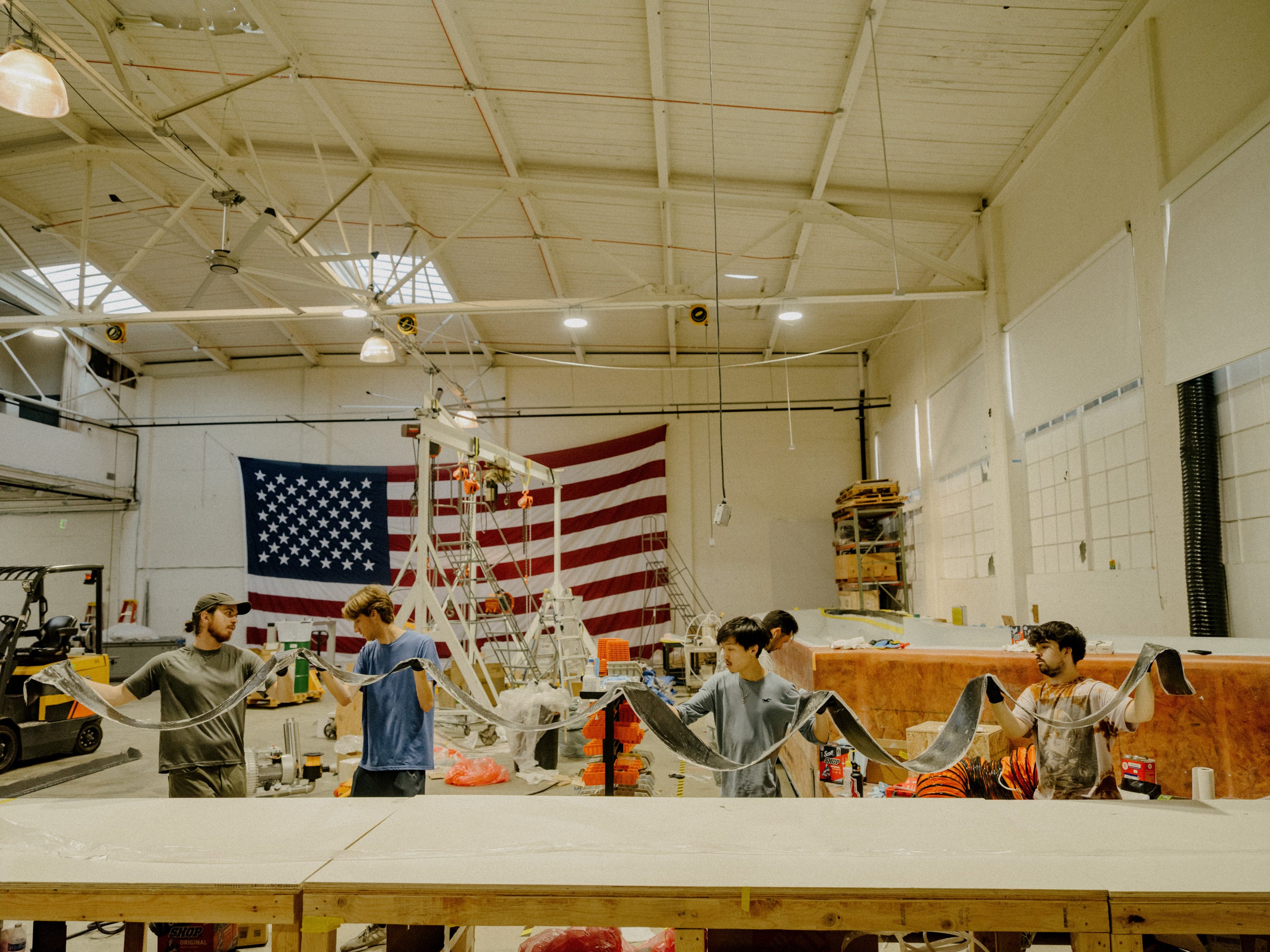
While many of America’s greatest minds are obsessed with creating artificial intelligence that will augment white-collar jobs—building ways to do online banking better or making online agents that can talk to other online agents—Poseidon, which raised $11 million in November, is producing machines that can do things in the real world. The seaplanes are named after birds—there’s a Seagull, a Heron, an Egret—and they can be used to ferry food to islands in an archipelago, or supplies to an oil rig. Or even weapons to an aircraft carrier. (The planes are remotely operated, via Starlink.) The government could theoretically store and launch drones from a Poseidon plane that floats miles offshore. In fact, the company’s website has an entire section dedicated to “POSEIDON DEFENSE,” which includes a map that shows how a plane in the sea around the southern tip of Japan could reach Taiwan, Guam, and our allies in South Korea. It is overlaid with text that reads: “BRINGING AMERICA’S ARSENAL TO OUR ADVERSARIES’ DOORSTEP.”
