


The murder of UnitedHealthcare CEO Brian Thompson earlier this month appears to be what it looked like: a political attack. In this case, one motivated by hatred of the American insurance system. In a leaked manifesto, the alleged killer, Luigi Mangione, blames the insurer’s corruption and greed, and claims to be the first to face it with “brutal honesty.”
If true—and a grand jury in New York will soon decide—that makes the murder another in a string of ideologically motivated violent attacks over the past few years, including:
Assassination attempts—two against Donald Trump as well as the shootings of Rep. Steve Scalise and (further back) Rep. Gabby Giffords;
Political riots, from the BLM violence of summer 2020 to the riot in the Capitol on January 6, 2021, to the pro-Hamas riots of last fall;
Intimidating protests against Supreme Court justices, or individual attacks like the assault on Paul Pelosi;
A wave of bomb threats as well as the pipe bombs mailed to prominent Democrats in 2018, reflecting domestic terror hitting its highest level in decades.
None of this is new. The late 1960s and early 1970s were wracked by political violence.
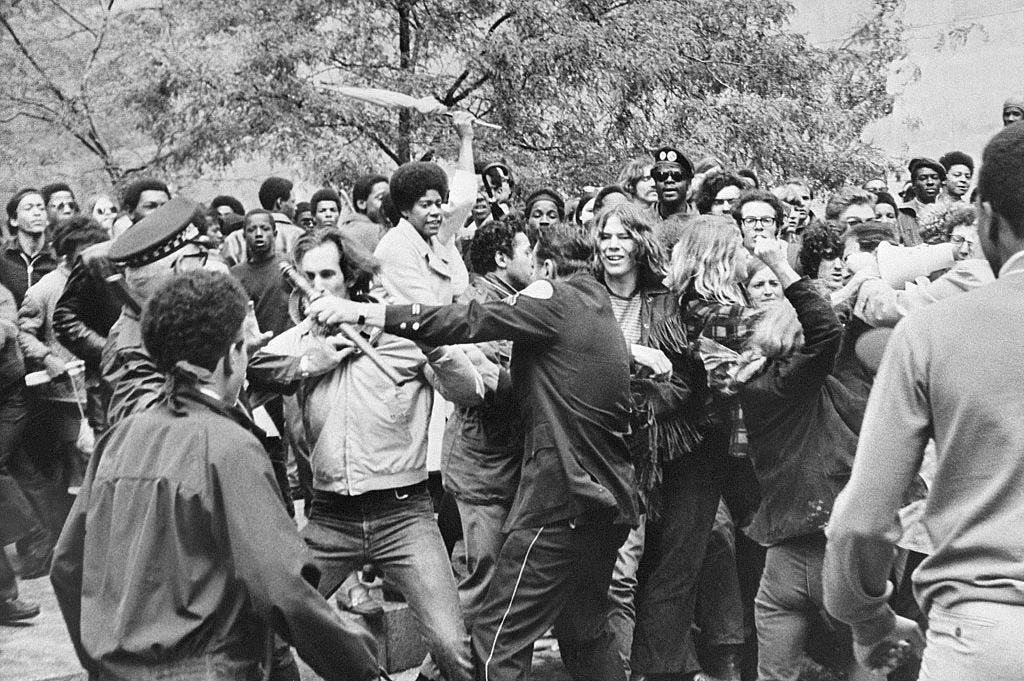
There were the assassinations—of JFK in 1963, MLK and RFK in 1968, and two attempts on Gerald Ford in 1975. There was rioting, culminating in the “long, hot summer” of 1967, which saw over 150 incidents, 83 deaths, and half a billion dollars in property damage within America’s urban ghettos. And there was terrorism, by groups like the Weather Underground, a far-left organization founded by university students, which committed dozens of bombings including of the Pentagon and U.S. Senate.
All of that feels like a world away. Indeed, many people under the age of 40 might be shocked to read about how regular political violence was in this country. That’s because between then and now, even as other crimes like murder and assault soared, political violence became almost unimaginable.
