


Donald Trump’s Monday announcement suggesting a link between Tylenol and autism has ignited a political firestorm over the condition’s origin and treatment.
Too often lost in the noise, however, are the individuals living with autism every day. One such individual is Leland Vittert. Now the chief Washington anchor for NewsNation, Vittert previously spent more than a decade at Fox News covering conflicts from the ground in Egypt, Israel, Libya, and Ukraine.
Reaching that level of success would be difficult for anyone—but Vittert faced steeper odds than most. Born in the 1980s with what is now often called high-functioning autism, he struggled for years to read social cues or connect with his peers, enduring relentless bullying.
In another family, he might have been pulled out of school and siloed from normal life. Instead, his father dropped everything to teach his son how to adapt to the world—and thrive in it.
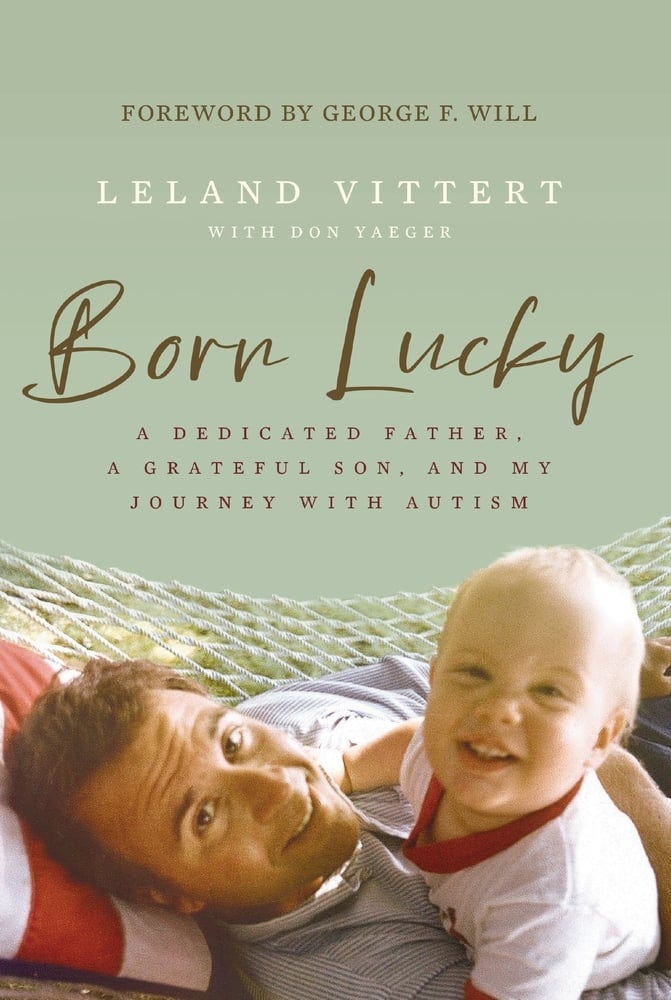
Vittert’s memoir, Born Lucky, is out September 30. And next week, he’ll be sitting down for a conversation with Bari about his remarkable journey. In the meantime, we’re delighted to publish an exclusive excerpt from the book: a love letter from a grateful child to a father who never gave up on him. —The Editors

When I was a kid, experts didn’t have a name for what I had. Asperger’s wasn’t a term until the 1990s, and autism wasn’t understood to be a spectrum disorder. The only diagnosis they could offer was “social blindness,” or “pervasive developmental disorder,” which gave my parents little hope things could get better.
In fourth grade, my school brought in a specialist to administer an IQ test. A learning disability was usually defined by a 20-point spread between the verbal and nonverbal halves. My spread was 68 points. On one end of the spectrum, I was a genius. On the other, I was considered, in the medical jargon of the 1980s, mildly retarded. Math and science came easily; social reasoning was hopeless. If they could have measured my emotional intelligence, it would have been near freezing.
Today, most parents would probably send a kid like me to therapy. Even back then, a diagnosis might have gotten me significant special treatment. But my dad knew that there wasn’t a teacher or therapist who could step in and suddenly make me fit in. The world wasn’t going to adapt to me, and he wasn’t going to try to make it. There would be no therapists or accommodations. If I was going to succeed, he would have to adapt me to the world.
