

One winter morning in a field beyond London, a gas main explodes. Hours later, small fires break out at the substations that supply Britain’s capital with electricity. Heathrow, the world’s second-busiest airport, shuts down. The lights go off in the Tube, Europe’s third-busiest underground metro system. The screens turn off at the London Stock Exchange—and the British pound plunges. As commuters begin the long walk home, panic buyers strip the supermarkets.
With street lamps dead, the London skyline goes black for the first time since 1945. Looting and arson begin. Fire crews are attacked and police stations burned. The lights go out in Birmingham and Manchester, Britain’s second- and third-biggest cities, and the chaos spreads to the rest of the country.
Rumors fill the vacuum: A senior politician has been assassinated, the water is unsafe to drink, prisoners in Britain’s crowded jails have been burned alive in their cells. On social media, you see masked gangs of white people and Muslims facing off—if your phone still works.
Burning vehicles block the highways that resupply the cities with food. There are hundreds of thousands of legally held guns in Britain, but the police are almost all unarmed. A few shots are enough to hold up trucks at key junctions and send police scurrying for cover.
The prime minister addresses the nation on the BBC, though most people can’t see the broadcast, and the King assents to calling out the army. But the troops are divided between enforcing order, fixing and guarding infrastructure, and trucking emergency supplies into the cities. They take days to restore order, including with live fire—only for a further round of infrastructure disruption to break out a few days later.
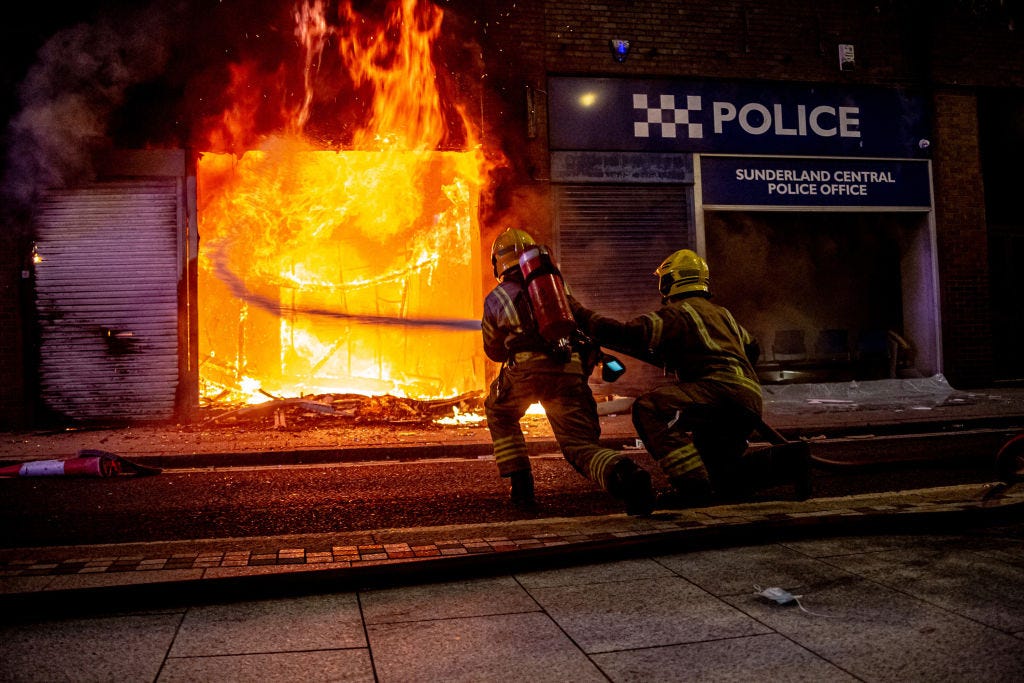
Somehow, a handful of vandals have brought a nuclear power to its knees. By now, everyone knows it isn’t Russia. It isn’t homegrown Islamist terrorists, either. It’s the members of the indigenous English majority rising in a nativist revolt against the state, the immigrants in the cities, and the Muslim minority in particular.
This, says David Betz, a historian at King’s College London, is how England’s civil war begins—and he believes it’s already underway.
