

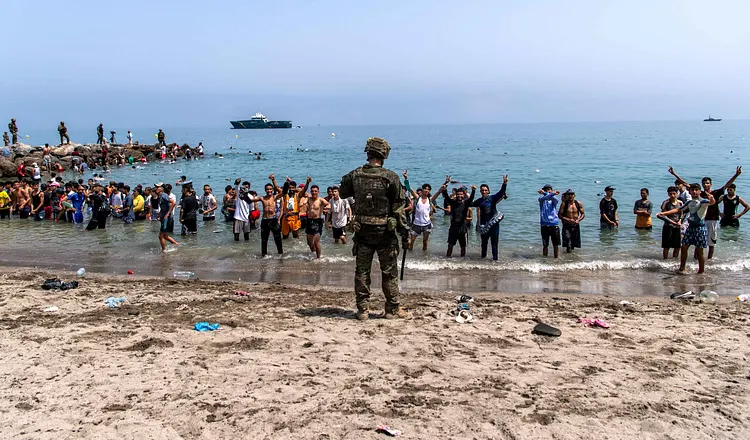
The images were unforgettable. More than 60,000 migrants entered the tiny Spanish territory of Ceuta from Morocco over the course of 24 hours.
It’s arguably the most vivid illustration we’ve ever seen of the migrant crisis that has transformed the face of Europe in one decade and that continues to consume the continent’s politics. And no one saw it all coming more clearly than our own Douglas Murray. His 2017 book, The Strange Death of Europe, chronicles the errors of judgment that led Western leaders so carelessly to open their doors to unlimited migration.
Will the brief storming of Ceuta prompt a reckoning among European elites, or will the crisis linger on, with the same denials and failed solutions from the leadership class? Read Douglas’s take on what comes next. —The Editors

Eleven years ago, almost to the day, Europe was experiencing a migration wave that threatened to make the continent buckle. In the space of a matter of weeks, more than a million people from Africa, the Middle East, and the Far East made their way into Europe, principally by crossing to the islands of Greece and Italy: “the soft underbelly of Europe.”
As various European countries started to panic, it was German chancellor Angela Merkel who decided to control the day. “Wir schaffen das,” she said in August 2015. “We can do this.” Merkel and some of her counterparts in the EU effectively suspended normal immigration procedures and opened the borders of Europe to anyone who wanted to come.
In those days, the route into Europe via Spain was relatively quiet. That was because the option of getting into Europe via Central and Southeastern Europe had been opened up, so there was less need for migrants to use the Spanish option. There were also effective agreements with the Moroccan authorities—unlike those in lawless Libya, for instance—which saved Spain from the most challenging of the 2015 waves.
Still, Spain remained uniquely vulnerable. Not least because, like Greece and Italy, the country had an accident of geography. This was the fact that, as well as being a remarkably short sail from North Africa, Spain has two territories actually in Northern Africa: the enclaves of Ceuta and Melilla.
